‘Three Churches United’ Lead Effort to Celebrate Diversity; Honor Diocese’s First Black Priest
The weekend before Thanksgiving, the “Three Churches United” (downtown Charleston churches: Calvary, St. Mark’s, and St. Stephen’s) joined together for two important services. On Saturday, November 22, the Rt. Rev. Michael Curry, 27th presiding bishop of The Episcopal Church, and Bishop Ruth Woodliff-Stanley joined them to re-dedicate the grave of the Rev. Thaddeus Saltus, the first black priest of our diocese. Then on Sunday, November 23, the three congregations met for a combined service celebrating the Christian values of diversity, equity, and inclusion at St. Mark’s, with Bishop Curry serving as preacher. The Episcopal News Service covered the event and wrote the article that begins below.
From The Episcopal News Service (written by Shireen Korkzan): One year after an initial gathering for a solemn worship service of lament and repentance, the three historically Black Episcopal churches in Charleston, South Carolina, gathered again, this time for a weekend celebrating diversity, equity and inclusion, and to honor the diocese’s first Black priest. “The celebrations will remind us that we’re supposed to help reveal God’s kingdom in the advocacy work that we do,” the Rev. Ricardo Bailey, rector of Calvary Episcopal Church, told Episcopal News Service ahead of the Nov. 22-23 events.
Calvary, St. Mark’s Episcopal Church and St. Stephen’s Episcopal Church have formed a coalition they call Three Churches United. They have hosted and participated in several events as part of the diocese’s commitment to racial reconciliation work through its Diocesan Racial Justice and Reconciliation Commission. Part of those efforts include regularly hosting “learning day” events to teach the history of the Charleston-based Diocese of South Carolina.
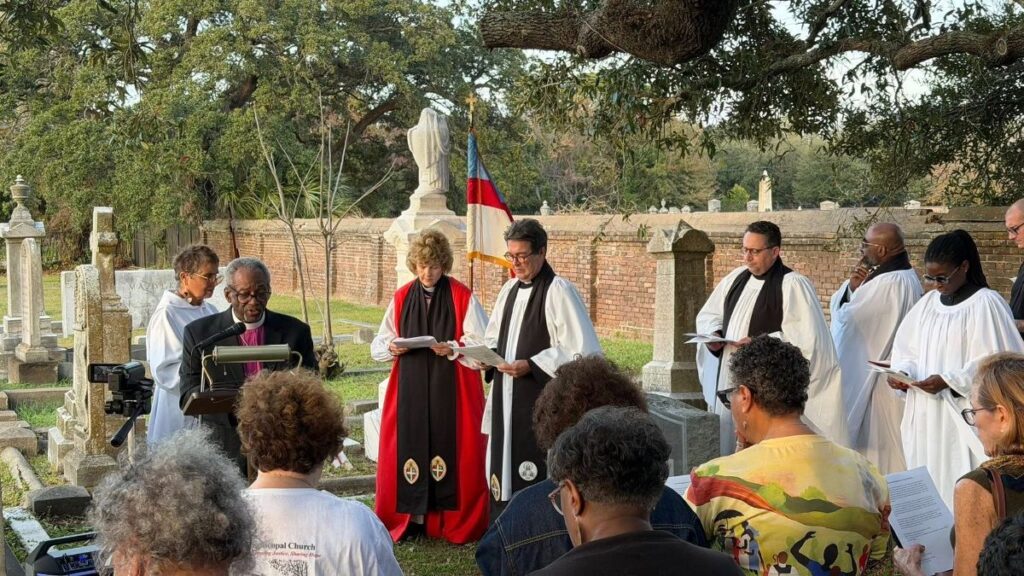
On Nov. 22, the diocese held a liturgy to bless and rededicate the gravesite of the Rev. Thaddeus C. Saltus, who was born a free person of African descent in 1850. Upon being ordained a deacon in 1881 and a priest in 1882, Saltus served St. Mark’s and was meant to become rector until he unexpectedly died in 1884 from tuberculosis at 33. He is memorialized at St. Mark’s through his name on its pulpit and on a stained-glass window.
Saltus’ gravesite was largely forgotten and neglected until his name and historical significance were mentioned in a learning day nearly two years ago, which prompted volunteers in the diocese to locate and restore it. Through diocesan documents and a listing on FindAGrave.com, an online cemetery database, Saltus’ grave and monument were found at Brotherly Association Cemetery in Charleston. A diocesan restoration committee worked with a local monument company to clean and repair Saltus’ monument.
“This kind of work is a part of our ministry of reconciliation and healing the wounds of history,” the Rev. Jennie Clarkson Olbrych, a priest who conducts historical research for St. Mark’s and who served on the restoration committee for Saltus’ gravesite, told ENS. The liturgy at Saltus’ gravesite included readings from Psalm 16 and John 14, and a reflection from South Carolina Bishop Ruth Woodliff-Stanley. Former Presiding Bishop Michael Curry also participated in the liturgy.
“Thaddeus Saltus faced many barriers – and the diocese at the time tried to limit his ministry to just African Americans without his consent – but he left an indelible mark in our history in a very short amount of time,” the Rev. Adam Shoemaker, rector of St. Stephen’s, told ENS. “This is why we have worked to lift up and illuminate for our diocese this real pioneer who easily could have been forgotten and lost to time were it not for this kind of collective effort.”
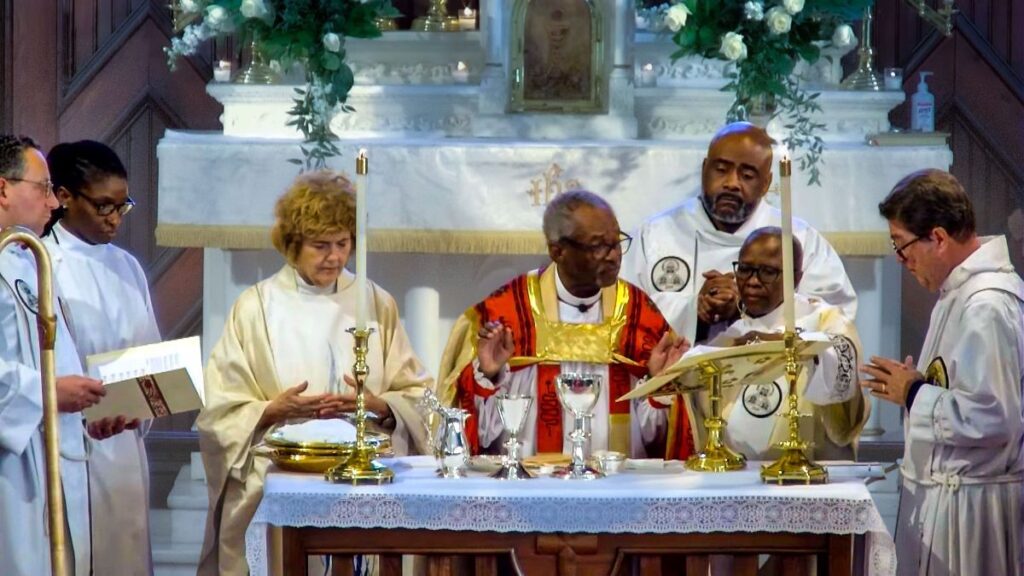
The next day, Nov. 23, St. Mark’s hosted “Gloria DEI,” a special livestreamed worship service celebrating diversity, equity and inclusion, commonly shortened to DEI. In the service’s context, “Gloria DEI” both means “Glory to God” in Latin and diversity, equity and inclusion. The choir of Voorhees University in Denmark, South Carolina, one of two historically Black Episcopal-affiliated universities, performed during the service. Curry preached and Woodliff-Stanley presided.
In his sermon, Curry said that anyone can “discover” diversity, equity and inclusion when they share “the love of Jesus.” He compared the Diocese of South Carolina’s racial reconciliation work to Moses “coming down to tell the Pharaoh, ‘let my people go’ … and coming down to deliver them from the Egyptians.”
“We need folks like you, like these [Three Churches United], like this diocese, who are not ashamed to call [Jesus’] name, not ashamed to be people of love,” Curry said.
U.S. President Donald Trump has, since taking office in January, signed executive orders banning DEI initiatives intended to prohibit discrimination based on race, gender, sexual orientation and disability. At the service, Bailey, Shoemaker and the Rev. Michael Shaffer, rector of St. Mark’s, all described celebrating diversity, equity and inclusion as “Christian values.” This is why, the priests said, having the “Gloria DEI” service the same weekend as Saltus’ monument rededication, and Curry’s presence as The Episcopal Church’s first Black presiding bishop, was “providential.”
“The accomplishments we’ve made as a diocese and as the Three Churches United in the last year is a furtherance of the kingdom of God, in celebration of diversity, equity, inclusion, fairness, justice that have been eroded in the last year,” Shaffer told ENS. “While we celebrate those, we need to be cognizant of the fact that there’s still work to be done.”
Read the full article on ENS at this link. Watch the full service on YouTube at the video linked below or at this link. The Voorhees University Choir provided special music for the service.