Diocesan Council Gathers for Retreat to Clarify and Define Purpose and Direction
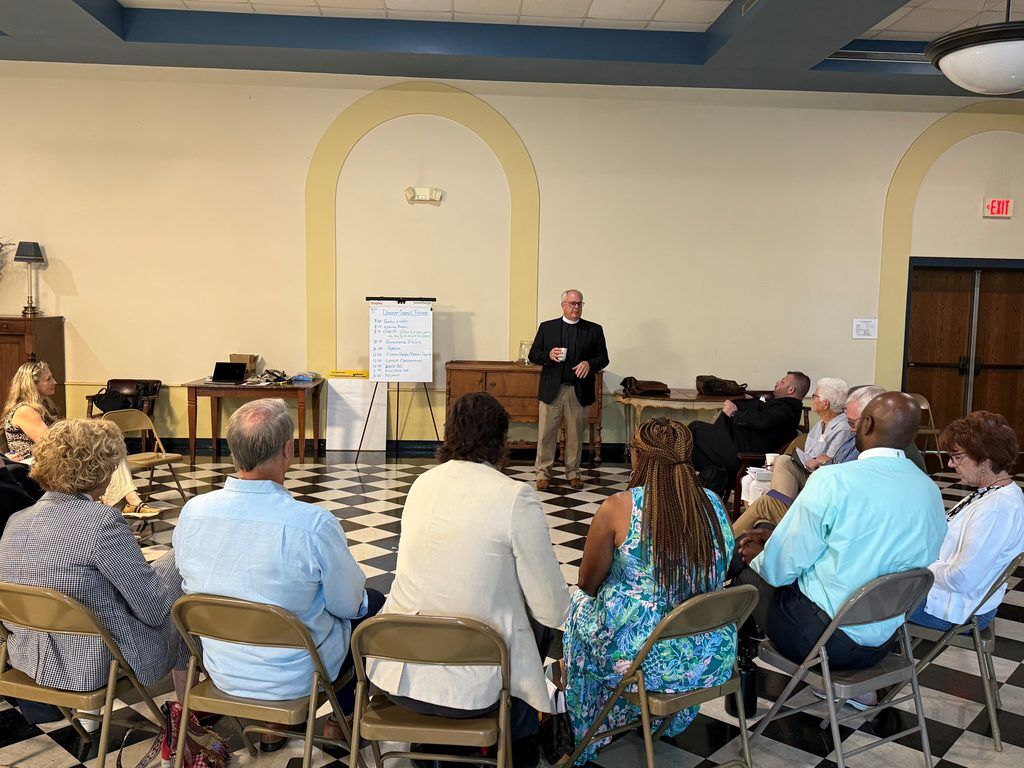
Recently members of Diocesan Council gathered with Bishop Ruth Woodliff-Stanley and members of her staff for a full day session at Holy Communion, Charleston, to take a deep dive into the purpose and mission of the group, particularly in light of its redefinition during last year’s diocesan convention. At that time, Convention elected to allow deaneries to elect their representatives on Diocesan Council (one clergy and one lay), with the deans serving in an ex-officio (non-voting) role.
The Very Rev. Joseph Smith, who serves as dean of the West Charleston Deanery and vice chair of Diocesan Council, offered the following reflection following this recent retreat that summarizes well the gathering and their charge moving forward:
A Reflection from the Vice-chair
Since becoming Vice Chair of Diocesan Council, it has become evident to me that one of the quiet truths of diocesan life is that most people have only a faint sense of what Diocesan Council is or why it exists. To be honest, those of us who serve on Council have spent a fair amount of time asking the same questions. Our work this year has centered on naming that reality with honesty and beginning the slow, Spirit‑led process of becoming the body our canons imagine.
Canon 15 tells us that Diocesan Council “shall administer and carry out the missionary, educational, and social work of this diocese… may initiate and develop new work between meetings of Convention… [and] shall receive and administer all funds raised for the purpose of diocesan mission and ministry.” The remaining sections of the canon describe how members are elected, who serves ex officio, and how representation is balanced across the diocese. What the canon does not give us is a clear sense of identity. It offers the gift flexibility, but that flexibility presents a challenge.
In my three years on Council, we have met in different formats: monthly on Zoom, quarterly in person with Standing Committee, and now quarterly in longer in‑person sessions. Across all three groups, one question has surfaced again and again: What are we doing, and why? Each Council has carried a yearning for clarity of purpose and a desire to understand how this canonical body can truly serve the mission of the diocese.
The clergy retreat this past May became a turning point. Grounded in our Baptismal Covenant, clergy engaged in honest conversations about the mission of the diocese, naming trends, patterns, and needs that point toward clarity rather than providing immediate answers. Those conversations helped us see that Diocesan Council is meant to be the body that helps deaneries and congregations stay linked to one another and to the wider mission we share. We call that the connective tissue. And yet, an honest assessment shows that we are still more on the becoming side of that identity than the embodying side.
This past week, Council gathered for a day‑long retreat to continue the work we began earlier this year. We spent time reflecting on our role, imagining what a fully functioning Council might look like, and considering how we might better serve as the connective tissue of the diocese. Our hope was simple: that the retreat would help us see the road ahead more clearly as we wrestled with some basic questions.
1) Where are we now in this process of becoming, especially as we support congregations in their Spirit‑led work? Where can we focus? Where do we begin?
2) How much change can we realistically take on at one time?
3) How well do we communicate across the various venues where diocesan life happens and where are the gaps?
Like the diocese itself, Diocesan Council is in a process of becoming. We trust that through steady diocesan leadership and our own prayerful, deliberate work, these questions will lead us toward faithful solutions. We can already see early signs of growth, and we look forward, hopefully and expectantly, to the good fruit that will strengthen our common life and deepen our shared mission.
God’s peace,
Dean Joseph+