Report from the 227th Diocesan Convention

More than 300 delegates, visitors and guests representing the 31 congregations of our diocese and friends from across the Church gathered at All Saints Episcopal Church on Hilton Head Island November 10-11 for the 227th Diocesan Convention of The Episcopal Church in South Carolina.
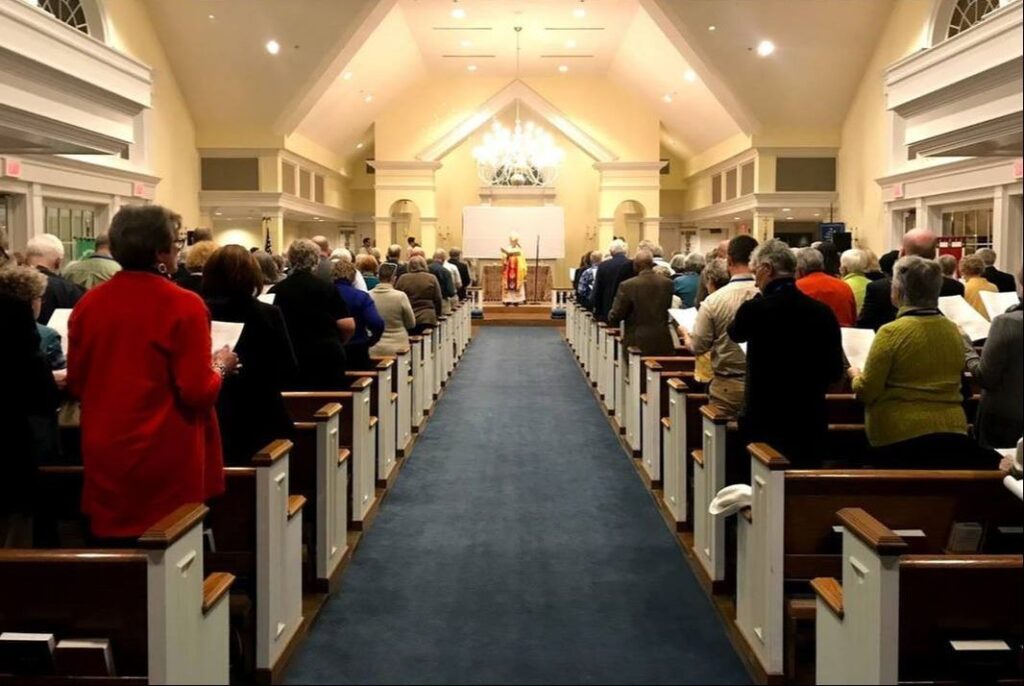
The theme of the Convention was “The Wisdom of the Body,” and the assembled body celebrated that theme through worship, meetings, workshops, presentations and an uplifting Convention Eucharist that included the annual address to Convention from Bishop Skip Adams.

​“In this relatively short time I have discovered that the wisdom of this body is broad and it is deep,” said Bishop Adams, who became Provisional Bishop in September 2016. “I remain grateful to God to be ministering with such a blessed group of faithful people. It brings me joy.”

The Bishop’s Address and transcript may be found below.

The Eucharist included scripture readings presented dramatically by the Sacred Storytellers of All Saints, including I Corinthians 12:12-27 (“For just as the body is one and has many members, and all the members of the body, though many, are one body, so it is with Christ…”)

Bishop Adams said St. Paul was making the point that “we are an organic unity, not derived from ideology or agreement on issues, but out of a relationship with a person, Jesus of Nazareth. Naming various parts of the body as examples of various responsibilities in the faith community, he says that no one part can say to another, ‘I have no need of you.’ Or to say it more positively, we need each other and must find a way to function that way.

“St. Paul is clear: the Body is one, and so it is with Christ,” the Bishop said. “We might call this ‘The Wisdom of the Body.’ It means the end of power plays, manipulation, the running of personal agendas and ‘my way or the highway’ reactivity that takes our marbles and goes home. All are watered of one Spirit. We come from the same source or faucet if you will, for ‘You are the Body of Christ and individually members of it.’”

He challenged listeners to offer their best to the Church and “seize the moment God is giving us,” encouraging parish and mission leaders to do a self-assessment by asking themselves questions such as:

  • What do you need to undertake in order to strengthen the life of your congregation and participate in the Wisdom of the Body?
  • What will it take for you to move out beyond self-care and mere survival to be a transformative Kingdom presence in your neighborhood and beyond?

“If we do this from a deeply centered place rooted in the wisdom way of Jesus, it will lead to action that is life-changing for all,” the Bishop said.
 
Saturday’s sessions

Saturday began with Morning Prayer, celebrating the feast day of St. Martin of Tours. It was also Veterans Day, and during the service, the Bishop presided over the profession of Brother Christopher Thompson (the Rev. Chris Thompson, interim rector of Holy Communion, Charleston), in the Order of the Hospitallers of St. Martin. This is a newly formed monastic community in the Episcopal Church, focusing on prayer, hospitality, and reconciliation for veterans. Read more about them here.

Convention Keynote & Workshop: The Rev. Bill Redfield

Most of the morning session was devoted to time with the keynote speaker, the Reverend Bill Redfield, retired rector of Trinity Church, Fayetteville, NY. Fr. Redfield brought his experience as an Episcopal priest, licensed clinical social worker, and student of Centering Prayer under Cynthia Bourgeault, leading a session that included times of quiet reflection, one-on-one conversations and deep sharing and listening.

Fr. Redfield said he wanted to “hold up a mirror” to the gathered representatives of our diocese and help them see themselves as Bishop Adams has come to see us in his year as our Provisional Bishop. “He has fallen in love with you, and it is that perspective of love that sees you as whole, and holy. …And that perspective is objectively and accurately real,” Fr. Redfield said.

Expanding on the Convention theme, “The Wisdom of the Body,” he spoke of efforts in the church to recover the ancient traditions of “body wisdom.” He encouraged the delegates to bring their attention to ways in which painful and difficult times they have experienced due to division in the diocese in recent years may manifest themselves physically. Rather than push those experiences out of their minds, he asked people to identify those feelings and regard them with love and compassion. Participants also spent time in pairs to take turns speaking and listening about those experiences.

“This is wisdom of the body – this is wisdom of the body faithful,’’ Fr. Redfield said.

Convention reports

Buck Blanchard, Officer for Global Mission Development for The Episcopal Church, talked about this new role in the Presiding Bishop’s Office, visiting parishes and missions to encourage individuals to answer their call to be involved in international mission work.

Anglicans around the world in 165 countries want the same things for their children we do, and they want to know us and make connections,” he said. “Say yes to the call. Don’t let fear keep you from doing it.”

Danny Sanford of the Still Hopes Episcopal retirement community in Columbia, one of the institutions of our diocese, reported on an exciting new intergenerational project being studied for the York Place campus.

The 80-acre York Place campus, long used as an Episcopal home for children, currently is unused and is ready to be revitalized. The Diocese of Upper South Carolina and Still Hopes discussed using it for senior housing, but also have begun to explore adding day programming for children.

Studies are under way to look at the market, the infrastructure, and what the local needs are in York County. Currently, studies are focusing on providing housing for elders age 55 and older combined with an early childhood program for ages 2-4. “We know that they will see their life enhanced and better outcomes for both sides,” Mr. Sanford said.

No resolutions were reported to the Convention. Only one was submitted to the Resolutions Committee,  and it was withdrawn. Committee members said the submitters’ concerns would be reported to our Deputation to General Convention and relayed through them to the wider Church.

Diocesan Treasurer the Rev. Jim Taylor reported that the state of the diocese’s finances is strong, and drew attention to the good audit report received in September. Convention delegates voted to approve the 2018 diocesan budget, which totals $602,548, up from $559,290 in 2017. The increase is funded by growth in the contributions of parishes and missions of the diocese.

Chancellor Thomas S. Tisdale Jr. gave a brief report, saying that “Our diocese is structurally strong and in good order.” He offered an overview of the status of legal matters and mentioned that mediation involving the diocese is scheduled to resume December 4-5. “Our first goal is one of constantly seeking reconciliation with those now separated from us,” he said.

Also on Saturday, the Convention commissioned our Deputies to the 79th General Convention of the Episcopal Church, which will be held in Austin, Texas, in July 2018: The Very Rev. Rick Lindsey, the Rev. Dr. Jim Taylor, the Rev. Wil Keith, the Rev. Jean McGraw, Pam Guess, Andrea McKellar, Lonnie Hamilton, Mark Szen; and Alternate Deputies the Rev. Cn. Dr. Wilmot T. Merchant II, the Rev. Cn. Caleb J. Lee, the Rev. Bill Coyne, the Rev. Jeff Richardson, and Carrington Wingard.

On Friday afternoon, a pre-convention roundtable discussion on the 79th General Convention was led by Fr. Lindsey, who is chair of the Deputation. (To follow our Deputation to General Convention and find contact information for the Deputies, visit our official General Convention blog: episcopalsc.blogspot.com)

All the detailed reports at Convention will be included in the official Journal of the 227th Diocesan Convention, which will be available on the website when it is completed. (Reports submitted by our diocesan institutions can be found here.)

Elections

Delegates voted during the morning session to fill seats on the Diocesan Council, Standing Committee, and the Board of Trustees of the University of the South. The following results were announced after lunch:

Standing Committee, Clergy
The Rev. Dr. George Moyser 
The Rev. Fred Thompson 
 
Standing Committee, Lay
Emily Guess 
Rick Stall 
 
Diocesan Council, Clergy
The Rev. Rob Donehue 
The Rev. Cn. Dr. Wilmot Merchant II 
 
Diocesan Council, Lay
Ray Wannamaker Sabalis 
Carrington S. Wingard
 
Trustee, University of the South, Lay
Tom Miller

At a brief meeting of the Standing Committee held immediately following adjournment, the Reverend Jeff Richardson was elected Standing Committee President.
 
The 228th Diocesan Convention
The Reverend Chris Thompson, Interim Rector of Church of the Holy Communion, Charleston, issued the invitation to our 2018 convention at Holy Communion. Watch for the date to be announced soon. ​


Bishop’s Address

Isaiah 11:1-9; I Corinthians 12:12-27; Matthew 26:26-30

We know the Wisdom of the Body when we see it. In Montana a Jewish family placed a menorah in their window only to come home and find its exterior and their yard vandalized and trashed. The next morning word got out, and by that evening all the people in that community, most of whom were not Jewish, had put a menorah in their own windows. The violence of that neighborhood ended because of a connective unification that stopped it. It arises on behalf of a larger purpose and is not based entirely on the knowledge of one person. This makes wisdom collective even as individuals act within its expression.

This is my body (point to self). This is my body (point to the altar). This is my body (gesture to the assembled people). The Wisdom of the Body comes from and leads to all of these locations of the individual and of the assembly, even from outside of ourselves as we take into our bodies sacramental outward and visible signs of the Christ among us and in us all. We ingest whom we already are and are created to be individually and corporately, the Body of Christ.

I have been among you one year and three months, present in every worshiping community at least once and some now twice or more. In this relatively short time I have discovered that the wisdom of this body is broad and it is deep. I remain grateful to God to be ministering with such a blessed group of faithful people. It brings me joy.

As I survey the lay of the land of our diocese, I note that the Visioning Committee is close to the conclusion of its work.  It will report before long to Diocesan Council and then decisions will need to be made as to how it is shared more widely for consideration as well as next steps to engage strategic initiatives in support of the vision and its implementation.

The Diocesan Council and other leadership will be engaging in a strategic communication plan in order to more broadly and effectively tell our story as a diocese of the Episcopal Church, who we want to be and become, using all the best tools at our disposal technologically, in the press and in social media, as instruments of the Good News.

As you know, we also are in the midst of mediation conversations with the disassociated diocese regarding diocesan and parish property, even as we wait for the State Supreme Court to respond to the motions of rehearing and recusal brought by the other side. Stay tuned. In all the above much is happening, much is unfinished and yet to be known. It is, at the same time, very rich and full of possibility. So what do we do along the way?

When Jesus shared a Passover supper with his friends and said, “this is my body,” what did he create? A community! A cosmological moment came to fruition during that Last Meal before his death where all time, past and future, was made present. God’s desire for us to enter into a new relationship with one another and the created order was again being revealed. We call it the Kingdom, or Reign, of God. Not only is it present now in glimpses, it is also an anticipation of a continually unfolding reality. As with all Body Wisdom, new perspectives are invited and it evokes higher aspirations. Often its emergence is grounded in a different way of listening and brings attention to the immediacy of the moment.

We, as in all of humankind, have been rescued by Jesus from all that destroys God’s creation. No longer constrained by death, we are now being made into a new creation as we are defined as Christ’s own forever. Jesus’ life has been “poured out” in the hope of reconciliation, thereby creating a community with new possibilities for life. It is this new community for which we have been created, a community that brings life to the world and one another. It has not been created primarily to gather in incessant meetings to repair roofs and replace boilers. We repeat the covenantal meal of relationship on a regular basis in order that we will always remember who we are, to whom we belong, and who God calls us to be.  

Then notice what happens in the Gospel. It is really quite stunning. After being identified with Jesus’ broken and wounded body, yes, for God’s Wisdom has become a body of real flesh and blood, before going out from the meal they sing a hymn, probably the Hallel Psalms 115-118. Do you get it? Vocalizing from those amazing folds within the larynx, they sing a new relationship into being and it takes every voice to make it so. The purpose is the praise of God as they sing themselves into unity! Then they go out, for from now on, their and our sole job is bringing about on earth the Kingdom of Heaven in its fullness – God’s vision of perfect justice and peace, and it starts in here (pointing to my heart).

So what of this new community we have been created to be? St. Paul gives us a compelling image familiar to most of us by naming parts of the body – feet, hands, ears and eyes, as an organic image of the Body of Christ. Where might he have gotten such a picture? All preaching, including that of St. Paul, is done in a context. In Corinth, where St. Paul was ministering to a newly founded church, there was a building called the Asclepion. People went there to find healing and left images and renditions of body parts, “ex-votos” as we call them now, to indicate a votive offering of devotion and gratitude for healing.

This image of the Asclepion was shown during the Bishop’s Address.

Such a practice is still done today all over the world in places of worship and at shrines although more often now with paintings, photographs and hand-written notes. St. Paul very likely borrowed from this cultural reality that he would have known well, prompting him to develop his image of the Body of Christ by naming body parts.

His point of course is that we are an organic unity, not derived from ideology or agreement on issues, but out of a relationship with a person, Jesus of Nazareth. Naming various parts of the body as examples of various responsibilities in the faith community, he says that no one part can say to another, “I have no need of you.” Or to say it more positively, we need each other and must find a way to function that way. St. Paul is clear: the Body is one and so it is with Christ. We might call this “The Wisdom of the Body.” It means the end of power plays, manipulation, the running of personal agendas and “my way or the highway” reactivity that takes our marbles and goes home. All are watered of one Spirit. We come from the same source or faucet if you will, for “You are the Body of Christ and individually members of it.”

Let me offer you another image. Have you ever seen a “murmuration?” Hundreds, even thousands of starlings flying together in a whirling, ever-changing pattern is a phenomenon of nature that amazes and delights. Take a look

The video above was shown during the Bishop’s Address.

How do they do that? As they fly they seem connected as they twist and turn at a micro-second’s notice.

Scientists have been surprised to learn that the flying pattern of murmurations have more in common with physics than biology. It is now believed that murmurations are similar to other systems, such as crystals forming, avalanches, metals becoming magnetized and liquids turning to gases. These systems exist on the edge, which means they are ready to be completely transformed in an instant. Like the elements in these other systems, each starling in a murmuration is connected to every other starling. The Wisdom of the Body! When one turns a phase transition occurs. In St. Paul’s words, “If one suffers, all suffer. If one is honored, all rejoice,” because we have been made, through Jesus, into a new community for God – “This is my body.”

The implicit model of American Christendom we have received and too often absorbed is that our main job is to break down people’s resistance to going to church – just work harder to get them to come. What is being called forth, however, is vastly different. It is a community able to turn in an instant, to live on an edge that is focused on being the Reign of God present in your community. This is not for the sake of those on the inside of the Church, but for the sake of those of our neighborhoods, whether one block away or half-way around the world.

It was John Chrysostom in the 4th century who said, “This is the rule of the most perfect Christianity, its most exact definition, its highest point, namely, the seeking of the common good…For nothing can so make a person an imitator of Christ as caring for their neighbor.” Brian McLaren would help us see that “In a pluralistic world, a religion is judged by the benefits it brings to its nonmembers.” And why not call upon our own blessed Bishop Guerry one more time who clearly understood the Wisdom of the Body when he said, “We are called upon to preach…a social righteousness; a corporate salvation of each individual member of the community. It is not enough that the individual, viewed apart from society, should repent and be saved. He must be saved – can only be saved – as he is a member of a family, of a Church, of a regenerated and redeemed social order…A less comprehensive Gospel we cannot preach.”

This must be our focus. To do so in the world we have inherited in 2017, recall what Julia Stetcher said on Twitter through a Lutheran pastor, “We are at serious risk of being a Blockbuster Church in a Netflix world.” When it comes to communicating God’s Good News, we must be smarter than our so-called smartphones and smart TV’s. We need to know for example that millennials don’t buy into traditional hierarchies. If we are going to reach them we must be aware that they relate through networks, causes and story-telling. What does that mean for the kind of Church we are going to be? We cannot be about protecting self and our own interests. Christianity is a call to a relationship that changes all other relationships. It is our phase transition, like the starlings.

When we dare to live on the edge and take risks, even to fail, the results we get are like when about 43 years ago a group of brave women stood together in a church in Philadelphia to be ordained. We in The Episcopal Church in South Carolina are reaping the benefits of that Wisdom of the Body even as it occurred at great cost for some. The Wisdom of the Body continues to be manifest as now it is permissible to ordain women to the episcopate in the Church of England. I give thanks to God that my daughter does not know of a Church that does not ordain women. The holy work of inclusion must continue to be our work among “all tribes, languages, people and nations” as long as there are people pushed to the margins, their dignity diminished, and the image of God in them unrecognized.

Some of you are aware that one of the main foci of the Fellowship of South Carolina Bishops is our concern for public education in South Carolina. It is a matter of justice as it involves issues of racial equality, violence, poverty, fair distribution of resources and class. I am aware of a public school in the South Bronx brought about there by the leadership of an Episcopal Church, where the percentage of students going to college is 98% when the other schools in the area are sending 16% to college. The reason? Some believe that even beyond good educational models, it is the system of love, support and accountability shared in the surrounding community and encouraged by the Church, that leads to such positive outcomes. The Wisdom of the Body!

It was Martin Luther King, Jr., who observed that, “The arc of the moral universe is long, but it bends toward justice.” We need to participate with God in the bending.  It is the hope as shown forth in Christ that urges us forward to live into the great vision of Isaiah. “A shoot will come forth from the stump of Jesse.” Rooted in history, connected to the Wisdom of the ages, we discover once again that true religion brings peace where the created order is reconfigured. Once again we are given a call – to delight in the awesomeness of God as we seek to make it so, which is, in the Wisdom tradition, the favorite quality of human beings.

This Diocese, gosh, the whole Church, no, the world, needs your wisdom. It is why we cannot say “I have no need of you.” We need, together, to be offering our best to re-imagine our structure in the local parish and diocese along with the entire Episcopal Church, to re-imagine the language we use to communicate eternal truths, to seize the moment God is giving us to assure that the main thing really is the main thing – the Reign of God. I have a hope that our parishes will learn to share resources with one another and find ways to come together to do this work, to participate in the Wisdom of the Body. We are reminded in the book The Wisdom of Crowds that, “when more are involved it is more likely we will get it right.”  Collective Wisdom tells us it “is about how we come to make sound judgments with others, touched by what is common and decent in all of us.”

I wonder if you would be willing to do a self-assessment in your vestries and parish committees. If you are not doing something like this from time to time, perhaps at your next gathering you could ask yourselves something like:

  • What do you need to undertake in order to strengthen the life of your congregation and participate in the Wisdom of the Body?
  • What will it take for you to move out beyond self-care and mere survival to be a transformative Kingdom presence in your neighborhood and beyond?

The way to start is “to be so developed in a prayerful, contemplative consciousness that it allows illusions and judgments to fall away,” so Rose Marie Berger would tell us. The purpose of leadership is “not to make the present bearable, but to make the future possible.” It is born in community. If we do this from a deeply centered place rooted in the wisdom way of Jesus, it will lead to action that is life-changing for all. Being a Christian is supposed to be a radical statement. Mature spiritual leadership is rooted in the collective of the Wisdom of the Body.

Yes it can all be scary. Yes we are sometimes filled with anxiety and fear, especially when it can appear that so much of what we have known is falling away. Yet our longing for God’s dream needs to exceed our dread of loss. We are followers of Jesus. “If we knew where we were going, we would not have to follow anyone” (Francis Wade). Again our call: Follow Christ into the unknown and do not do it alone, “for you are the body of Christ and individually members of it.”

For now – pray without ceasing, listen deeply, act boldly. Trust the gift of God’s Spirit among you. You are a blessed and beloved people. I am a witness to it! For you are the Wisdom of the Body, as Christ has made you to be.

Bishop Skip