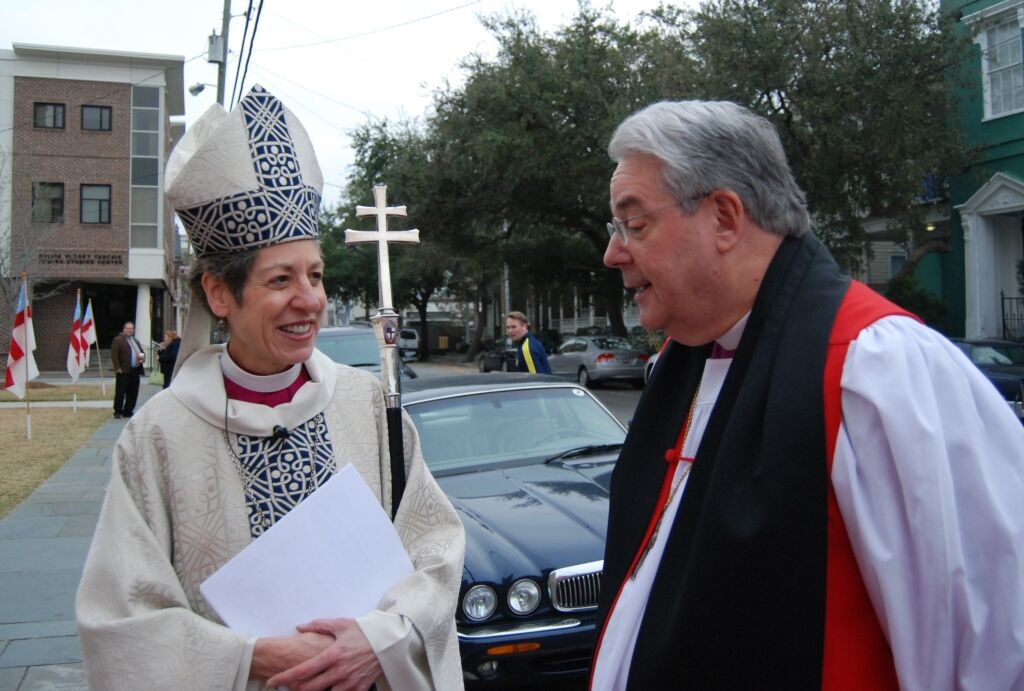
Video from the January 26 Convention
Download the Choral Eucharist service bulletin
Sermons and Addresses
The Presiding Bishop’s Sermon
January 26, 2013 at Grace Church, Charleston
Last summer, not too far from here, someone got excited and called the police about a plane flying near a nuclear power plant[1]. It was a glider – an unpowered plane with a human pilot – more substantial than a hang-glider, and definitely not a drone. It seems a local citizen thought this plane was flying too low and too near the power plant. Gliders don’t have engines, and they depend on air currents and updrafts to stay aloft. The pilot had made one turn near the power plant, which would be a likely source of rising warm air.
Well the pilot had gained enough altitude to turn for home when he heard somebody on the radio asking about an airplane near his position. He responded, saying basically, “that’s me,” and the person on the radio told him, in an embarrassed tone, that the local police wanted him to land. He landed at the Hartsville airport to discover a dozen police cars waiting for him. The local constabulary insisted that he had been flying in a no-fly zone. The pilot got out his charts and showed the officer that there was no such thing indicated on his chart. The officer arrested him, handcuffed him, and took him to jail. He was not permitted to phone the business from which he’d rented the glider that morning. They’d begun to worry, because he was well overdue. Eventually the plane’s owner heard from the FBI and Homeland Security that the pilot was in jail, for “breach of peace.” The Darlington County police kept this 70 year old man in jail for more than 24 hours, in a tiny cell with a dozen others, with no more than a dirty blanket.
He was released on bond a day later, and the charges were eventually dismissed, but he has yet to get any apology. The FAA is pretty upset, and so is Congress. Local police don’t have jurisdiction over airspace, and neither does the FBI or Homeland Security. These cops were flat out wrong.
I tell you that story because it’s indicative of attitudes we’ve seen here and in many other places. Somebody decides he knows the law, and oversteps whatever authority he may have to dictate the fate of others who may in fact be obeying the law, and often a law for which this local tyrant is not the judge. It’s not too far from that kind of attitude to citizens’ militias deciding to patrol their towns or the Mexican border for unwelcome visitors. It’s not terribly far from the state of mind evidenced in school shootings, or in those who want to arm school children, or the terrorism that takes oil workers hostage.
Most human communities, from churches to governments to families, function more effectively in response to shared decision-making. Most of us don’t live in a world where one person is the ultimate Decider – because, over and over again, we’ve discovered that better decisions are made when they’re made in communities with appropriate checks and balances. Power assumed by one authority figure alone is often a recipe for abuse, tyranny, and corruption. That’s why Jesus challenges us to think about how the shepherd acts. The authentic ones don’t sneak over the wall in the dead of night. They operate transparently, and they work cooperatively with the gate-keeper himself.
Today is the feast day for Timothy, Titus, and Silas. They were early disciples of the Jesus movement, and they offer a constructive example of the same issues. The early Christian community has been wrestling with what it means to be a faithful follower of the law as a Gentile – how much of the Jewish law applies to these new followers of Jesus? Paul and Barnabas set out to visit Antioch, sent by the group of leaders in Jerusalem, who have chosen Silas and a couple of others to go with them. They take a letter from the council with them says, “we know you’ve heard rumors about us and our decision-making, so we’re sending these people to share with you what has actually been decided. We think you’ll discover that the rumors aren’t as extreme as the reality. We’re not increasing your burdens, we’re trying to simplify them.” The council has decided in a minimalist way – circumcision is not required, nor must the gentiles follow all the dietary laws. Just a few things: don’t eat food that’s been blessed in pagan rites, and don’t eat meat from strangled animals or that still has blood in it. But the struggle continued over whether that was adequate observance.
It’s the kind of question that we will never hear the end of, for the challenges of human communities continue to evolve – because God’s creative spirit continues to draw us on toward the fullness of the reign of God. We’re not there yet, and that means change will continue until the end of all things. You heard Isaiah’s prophetic words, “former things have come and gone; I (God) am doing a new thing.” In a very real sense, we cannot remain faithful and refuse to wrestle with change. It doesn’t mean blind accommodation to developments around us. It does mean discernment in community about the direction we believe God is leading.
Well, before very long Paul and Barnabas split up, after a fight about whether or not to take John Mark with them. Paul was angry that Mark had left them when they were in Perga and gone back to Jerusalem. There’s no account of the split between Paul and Barnabas ever being healed. Being right may feel good for a moment, but the consequences often last a long time. Nor was Paul always consistent. He soon decides that Timothy must be circumcised, in spite of the Jerusalem decision, because his mother’s Jewish.
The hard questions aren’t usually decided immediately or by individuals, but by entire communities struggling through the difficult implications and the normal human resistance to change. The community wrestles and after a while finds itself in a new place, still in faithful relationship to God, whether they’re in Egypt, wandering in the wilderness, in Judah and Israel, Babylon, or South Carolina.
The question is less about who’s right and who’s wrong in the midst of the current controversies. It’s more about how we deal with those who disagree – the other sheep in the flock, and the variety of shepherds around us. Are we going to be good shepherds, partnering for abundant life? The saints we remember today didn’t do it perfectly either. They wrestled with the questions, came to varying conclusions, and kept on wrestling. Luke’s account is a pretty honest tale about their differences. Eventually, sometimes years or even centuries later, the community came to some consensus about food rules and circumcision. We’re still struggling over other issues, like whose voice is authoritative and where and with whom true love may be found.
Let’s go back to the pilot and the cops for a minute. The situation escalated when the local law enforcement who thought they were right failed to consult. They made a bad decision and then couldn’t or wouldn’t back down or try to rectify it until the whole thing had become patently absurd. I am immensely grateful that one officer didn’t follow through on his first threat, which was to shoot the glider down.
What are those of you in this Diocese going to do in your interactions with those who’ve departed? Are they law-breakers who should be shot down or thrown in jail? Do we see them as vigilantes? Neither is going to produce more abundant life, my friends. When you meet them out there in the pasture, consider that some of the sheep may think they’re listening to the voice of the Good Shepherd. Some are also simply exhausted.
What about the sheep who aren’t in the fold, who don’t know there is a feast to be found, rest for the body and soul, and partners who are willing to wrestle with the dictates of petty Deciders or wolves who masquerade as sheep? We all have a responsibility to be shepherds, to help others find their way through the Gate of abundant life. And believe me, that world out there is filled with hungry, lost sheep. Your experience of abundant life here has something to do with finding them.
We share a responsibility for all the sheep, to safeguard their lives and pastures, but it doesn’t give us carte blanche to shoot potentially errant ones out of the sky. Angry responses to trespassing often produce that kind of response. God’s feast doesn’t need “keep out” signs – the picnic on the grass is open to all who are hungry, who need rest, who seek peace and justice and healing.
The sheriff was right about a breach of peace, but wrong about who instigated it. Our task is to heal the breach, particularly with those who are seeking rest and a feast. The banquet table is spread with abundance for all, even though it’s hard to join the feast if you’re busy controlling the gate. The Gate himself has already done that work, and the word is out, “y’all come! Come to the feast!”
The Most Rev. Katharine Jefferts Schori
Presiding Bishop and Primate
The Episcopal Church
[1]http://www.aopa.org/aopalive/?watch=ZodG45ODqmBqYkQwWPCzO3XB1YlUcWPk
The Right Reverend Charles vonRosenberg
January 26, 2013
Grace Episcopal Church
Thanks
First of all, on behalf of the diocese gathered here, I want to express heart-felt thanks to our Presiding Bishop. For your presence with us, for your gracious leadership, and for your support of us in South Carolina, we give thanks to you and to God. Thank you, so very much!
In addition, I want to thank those who have worked so hard in preparation for this day. The Steering Committee for the Reorganization of this diocese – convened by Tom Tisdale and chaired by Hillery Douglas – have done great work. I am very grateful also to the clergy, the staff, and parishioners of Grace Episcopal Church, who have labored tirelessly over details in order to provide us with a wonderful setting for this convention.
And, I want to pay special recognition to those faithful Episcopalians – clergy and laity -throughout the diocese, who have struggled and persevered to claim their heritage, often in unlikely and less-than-ideal circumstances. Job well done! As we all know, there is much more work to do.
Also, I want to express my thanks to the delegates of this convention, for the honor and the trust you have given me. As I have said in public interviews recently, The Episcopal Church has been my home and Episcopalians have been my spiritual family for all of my life. Therefore, I feel a dual sense of gratitude and of responsibility as I accept the honor and the trust that you convey to me this day. We have quite a task ahead of us – but with the support of each other and by the grace of God, we will be successful. May God grant us the wisdom, the perseverance, and the grace necessary to accomplish His will in this diocese and at this time.
Last, but certainly not least, I want to say a special thank you to my partner in life and in ministry, Annie vonRosenberg.
Introduction
Some of you may have heard previously of a comment I made to Annie prior to our move to South Carolina. It seems appropriate to mention it again here. As we were packing to leave East Tennessee a year and a half ago, I said, “All of the moves we’ve made in our married life have been because of the church. But this move will be in spite of the church!” That comment seems at least ironic in the present moment – and perhaps even prophetic, in a strange and contradictory kind of way.
In any event, here we are – a group of people committed to The Episcopal Church – some, sadly displaced from their spiritual homes; others, finding new life in exciting times; and a bishop who thought he had retired. Indeed, here we are – facing an uncertain future; relying on others for strength and support; and depending on God’s grace in the tomorrows that await. It sounds almost like New Testament Christianity, doesn’t it?
In my remarks today, I want to use the image of rebuilding, for that is what we are called to do – to reorganize and to rebuild The Episcopal Church in South Carolina. I have several building blocks to suggest to you. There are and will be others, certainly. This is not an exhaustive list, but it mentions a few, at least. However, before considering building blocks, we need first to think about the foundation on which we are to build.
Foundation
St. Paul wrote to the people of the church in Corinth, “No one can lay any foundation other than the one that has been laid; that foundation is Jesus Christ” (I Cor 3:11). And those words of St. Paul we must remember in our day and in this diocese. Jesus Christ is our foundation. On that firm foundation we must rebuild. In particular, two Christly virtues for our foundation in South Carolina are these: humility and love.
All of us who claim to be followers of Jesus Christ have good reason to seek God’s forgiveness for our failure to achieve Christian unity in our time. Before our Lord was arrested, he prayed for the unity of those who would follow him. St. John records these prayerful words of our Lord – about his followers and addressed to God the Father: “I ask not only on behalf of these, but also on behalf of those who will believe in me through their word, that they may all be one” (17:20-21). We do indeed – all of us – have good reason to seek God’s forgiveness for our failure to live into our Lord’s prayerful wish – his dream for Christian unity.
The history of the church, though, contains a record of many others who share in this failure. We are not unique in our current circumstances. The apostles split before Jesus died. And such splitting has continued throughout history. The existence of denominations testifies to the failure of our efforts on behalf of Christian unity. And the current situation in South Carolina is further evidence of the same. Therefore, Christian humility needs to have a place in the foundation on which we are rebuilding. There is no place for self righteousness here … but there is much room for humility. May we, therefore, claim the Christian virtue of humility as an important part of our foundation.
In addition, as followers of Jesus, we need to recognize that other sincere Christians – former Episcopalians – have chosen a different path from ours. Theirs is a path committed to faith in Jesus, as they understand that faith. Thus, our intentions, in many ways, mirror each other, even though our paths diverge at this point in history.
Therefore, it is appropriate to pray for one another and to wish each other well on our separate ways. While we have failed thus far in our efforts toward Christian unity, our Lord will ultimately succeed, on his day. When that day comes, I want to greet fellow Christians as friends, not as enemies. Thus, in the meantime – before our Lord’s return – the appropriate attitude toward fellow Christians on a different path is love. May love, therefore, provide another essential ingredient in the foundation on which we build.
Building Blocks
Now, let me turn our attention to several building blocks, to place on the foundation of humility and love. As I mentioned earlier, this is not an exhaustive list, but these at least will give us cornerstones for the work to come.
First, we are not alone. We are part of The Episcopal Church … and, through The Episcopal Church, we are part of the world-wide Anglican Communion. Indeed, the one recognized, participating member of the Anglican Communion in the United States is The Episcopal Church. In South Carolina, we have a particular mission and ministry in this part of God’s kingdom But we are not alone. We are not independent. We make no claim of sovereignty. We are part of something much bigger than ourselves – the one, holy, catholic and apostolic church of our Lord. We are accountable, therefore. And, we thank God for our union with others in Christ.
Secondly, the tent which is The Episcopal Church is wide and broad. All may seek shelter under this tent. If I may mix metaphors for a moment, the tent actually covers a family … a very extended family. That is, under this tent, not everyone agrees on much of anything – like in a big family. We are not under the tent because we are like-minded or because we agree on everything … but because we are a family. With all of its diversity recognized and embraced under this tent, we thank God for our family of The Episcopal Church!
Thirdly, as we rebuild this diocese, we also will reclaim classic Anglican, Episcopal theology. This cornerstone offers access to a rich heritage, which we need so very much. For instance, sources of authority – from the beginnings of Anglicanism – have included scripture, tradition, and reason. Protestant denominations who hold only to scripture as authoritative have offered great gifts to the world … but that is not who we are, as classical Anglicans, representing the Anglican Communion in this part of the world. Therefore, in addition to holy scripture, the traditions of the church through history and our God-given reason also possess authority for us. We give thanks for such classic Anglican, Episcopal theology, which we will reclaim, even as we rebuild this diocese.
A fourth and final cornerstone may be most important of all – and that is an emphasis on mission. The Episcopal Church actually has another legal name – “The Domestic and Foreign Missionary Society.” Therefore, this cornerstone identifies who we really are. In this time of rebuilding for us in South Carolina, the temptation will be great to focus too much attention on ourselves. But, ironically, an excess of such attention would be over against our very identity. It was Archbishop William Temple who wrote, “The church is the only society on earth that exists for the benefit of non-members.” May we, therefore, with thanksgiving, embrace our identity in this cornerstone of mission.
Conclusion
By way of conclusion, then, we have a lot of work to do in the task of rebuilding The Episcopal Church in South Carolina. However, we have resources – both within this diocese and beyond it – to help us in the tasks ahead. I have suggested a couple of ingredients in a secure foundation on which we may build. And, I have offered four building blocks – cornerstones on which to build.
Let me close now with words from St. Paul, written to his beloved faith community in Ephesus. As your bishop, my own hope and prayer for you echo this petition of St. Paul:
“I pray that the God of our Lord Jesus Christ, the Father of glory, may give you a spirit of wisdom and revelation as you come to know him, so that, with the eyes of your heart enlightened, you may know what is the hope to which he has called you, what are the riches of his glorious inheritance among the saints, and what is the immeasurable greatness of his power for us who believe.” (1:17-19a).
Amen …. and thank you!
The Reverend Gay Clark Jennings, President of the House of Deputies
The Episcopal Church
My name is Gay Jennings and I am an Episcopalian. And I thank God you are too. My mother used to say that the only person who likes change is a wet baby. Change has been forced upon you, and I am here to tell you that the House of Deputies and the entire Church are covering you with prayer as you renew, reorganize, reorder, refresh, reconstitute, and indeed, resurrect the Episcopal Church in South Carolina.
Today, as you’ve heard from the Presiding Bishop, is the commemoration of Timothy, Titus and Silas, to whom Paul entrusted the work of building up the church. It’s an apt feast day for this convention.
Tomorrow’s commemoration of Lydia, Dorcas and Phoebe is equally apt. They were three devout women who also helped build the early church. We don’t know much about them since they were disciples at a time when women’s work went largely unrecorded. Lydia, we know, was a prosperous cloth merchant whose house served as a base of operations for Paul, Timothy, and their companions. Phoebe was likely the patroness of the early church in Corinth, and Dorcas devoted herself to works of charity in Joppa.
Lydia, Dorcas and Phoebe served God with the gifts they had been given. The collect for their commemoration asks God to “Inspire us today to build up your Church with our gifts in hospitality, charity and bold witness to the Gospel of Christ.”
Like in the early church, you faithful Episcopalians in South Carolina will need everyone’s gifts to create a new church for a new time. Some of you are the heirs of Lydia, Dorcas and Phoebe and serve God by providing hospitality, charity and witness. Others of you will witness to the Gospel or are already by feeding the hungry, healing the sick, and proclaiming justice for the oppressed. Still others of you will be elected today to serve in governance. Some of you will, when the election is called, be elected as deputies to General Convention, and offer your gifts to the church.
Whatever our gifts, Episcopalians are bound by the Baptismal Covenant, which is the foundational expression of our Episcopal identity. We are all ministers of the gospel by virtue of our baptism. It is our first and most important ordination for ministry.
When I wrote to you last month, I suggested that you take heart especially in our baptismal promise to seek and serve Christ in all persons, loving our neighbor as ourselves. As your Provisional Bishop noted, there are times ahead when that will be a hard promise to keep, — when it may seem as if the great breadth of conviction, experience and practice among Episcopalians threatens to overwhelm your longing for unity and clarity.
But if you look around this historic convention, and you remember the communion of saints that has gone before you, I hope you will be convinced, as I am, that our Anglican comprehensiveness is our particular gift from God and a great blessing for the Episcopal Church in South Carolina. Follow the Anglican middle way and it will guide you between extremes in the company of Christians from all walks of life and all gifts of the Spirit. The middle way is seldom the easiest path. It is easier to walk apart, surrounded by people who look like you, and think like you, and believe like you. But if you travel the middle way, you will find the fruits of the Spirit.
As you travel along the way that God is leading the Episcopalians in South Carolina, I will pray for you and walk with you whenever I can be of service. Please call or email anytime. We are all praying for you, and we are all eager to support you on your journey.
In the words of Philips Brooks, “Pray the largest prayers. You cannot think a prayer so large that God, in answering it, will not wish you had made it larger. Pray not for crutches but for wings.”
Thank you.
News Coverage
Episcopal News Service: “South Carolina continuing Episcopalians meet to plan their future“
The Post & Courier: “Continuing S.C. Episcopalians install new bishop, welcome leader of church, look to rebuild“
The State: “Lowcountry SC Episcopalians rally, elect leader“
Photos:
Gallery by the Post & Courier’s Grace Beahm
A photo album on Grace Church’s Facebook page
Schedule
Friday, January 25
4:00-5:00 p.m. – Meet and Greet the Presiding Bishop
Location: Grace Episcopal Church, 98 Wentworth St., Charleston (map)
Open to: Public
Cost: No charge
6:30-8:30 p.m. – Reception with the Presiding Bishop
Location: Bishop Gadsden, 1873 Camp Rd., James Island (map)
Open to: Delegates, clergy, invited guests and spouses
Cost: $25 per person
Details: Space is limited. Reservation information for the Reception will be sent to those who are registered for the Special Meeting of the Convention.
Saturday, January 26
Special Meeting of the Convention
7:30 a.m. – Registration Check-In. Coffee and continental breakfast items will be served.
9:30 a.m. – Choral Eucharist. Celebrant and Preacher: The Most Reverend Katharine Jefferts SchoriThe meeting will begin immediately following the service.
Location: Grace Episcopal Church, Charleston (map)
Open to: Preregistered delegates, clergy, visitors and media. Preregistration required by January 21, 2013.
Cost: $50 for delegates, $30 for visitors (details on registration page)
Lunch: Included with paid registration.
Clergy: All clergy are invited to vest and process. Liturgical color is white.